


Project Leads:
The Bioastronautics and eXploration Systems (BXS) Laboratory, WearLab
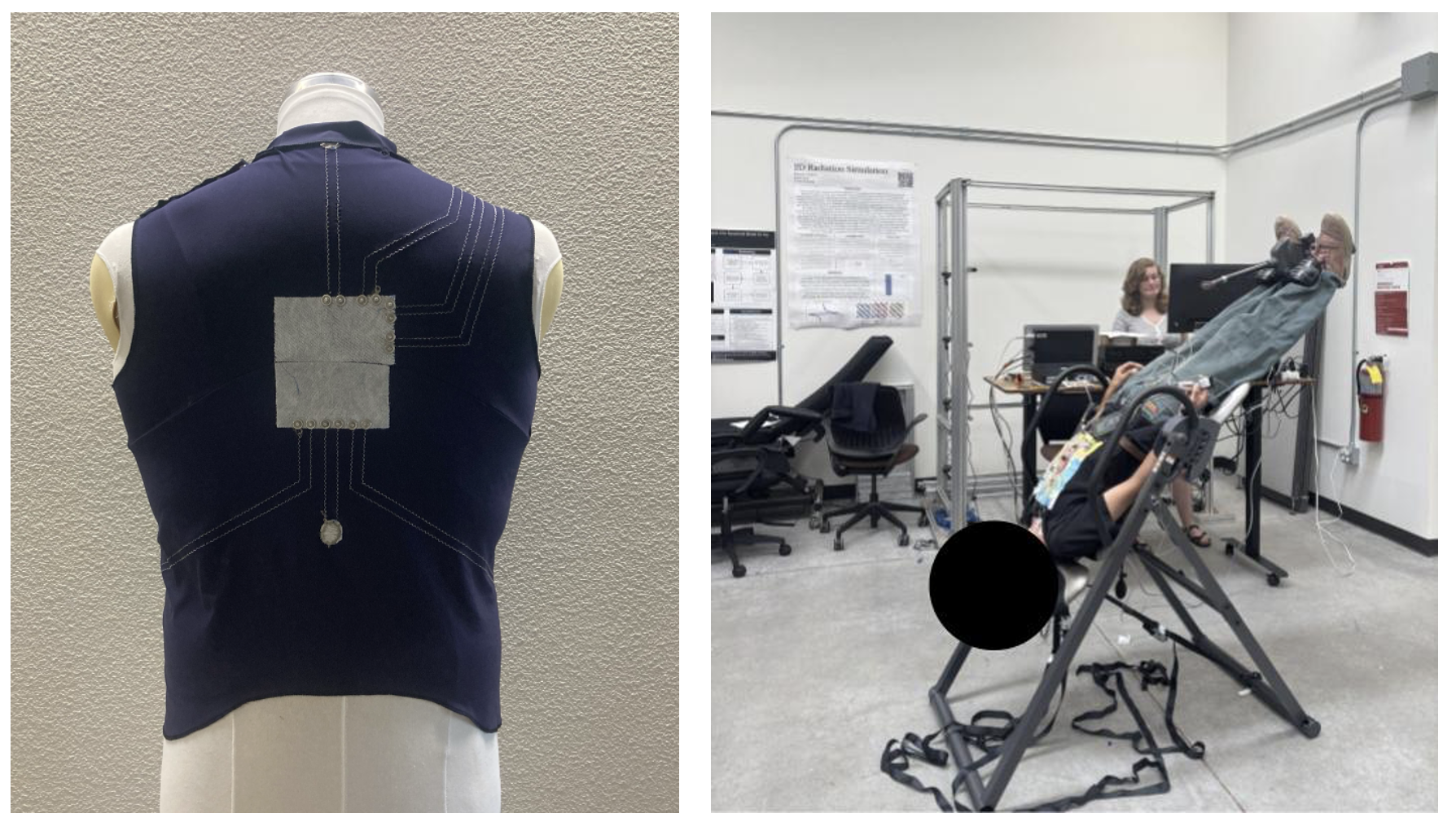
Microgravity induces fluid shifts and cardiovascular adaptations that can compromise astronaut health and performance, making reliable, continuous monitoring critical for mission safety. This work aims to deliver a validated, wearable solution capable of tracking real-time cardiovascular changes throughout the demands of space operations. The study focuses on developing and testing a comfortable, unobtrusive wearable device for continuous cardiac output monitoring in microgravity conditions. The wearable system captures hemodynamic parameters — including stroke volume and cardiac output — via impedance cardiography, without the rigid hardware or adhesive electrodes that make traditional monitors impractical in spaceflight settings.
Publications:
Waxman, S., Goncu-Berk, G., & Whittle, R. (2026). An embroidered e-textile garment for continuous, noninvasive cardiac monitoring via impedance cardiography. Proceedings of the 48th Annual International Conference of the IEEE Engineering in Medicine and Biology Society (EMBC 2026), Paper ID 4281. Toronto, Canada, July 26–30.
Waxman, S. M., Zhang, R., Goncu-Berk, G., & Whittle, R.S. (2025, June). Design and Implementation of a Wearable, Remote, Non-invasive, Continuous Cardiac Monitoring Device [Poster]. UC Davis Biomedical Engineering Research Symposium, Davis, CA.
Waxman, S.M., Zhang, R., Goncu-Berk, G., & Whittle, R.S. (2025, January). Design of a Wearable, Noninvasive Real-Time Cardiac Output Monitoring System. NASA Human Research Program Investigators' Workshop, Galveston, Texas.
Waxman, S.M., Zhang, R., Goncu-Berk, G., & Whittle, R.S. (2025, February). Design of a Wearable, Noninvasive Real-Time Cardiac Output Monitoring System. The Northern California Aerospace Symposium, Davis, California.