


HOMEO: Designing for Homeostasis, 2026 Savageau Award Winner
A wearable tVNS device for emotional self-regulation created by Rafael Bertacini, M.F.A.
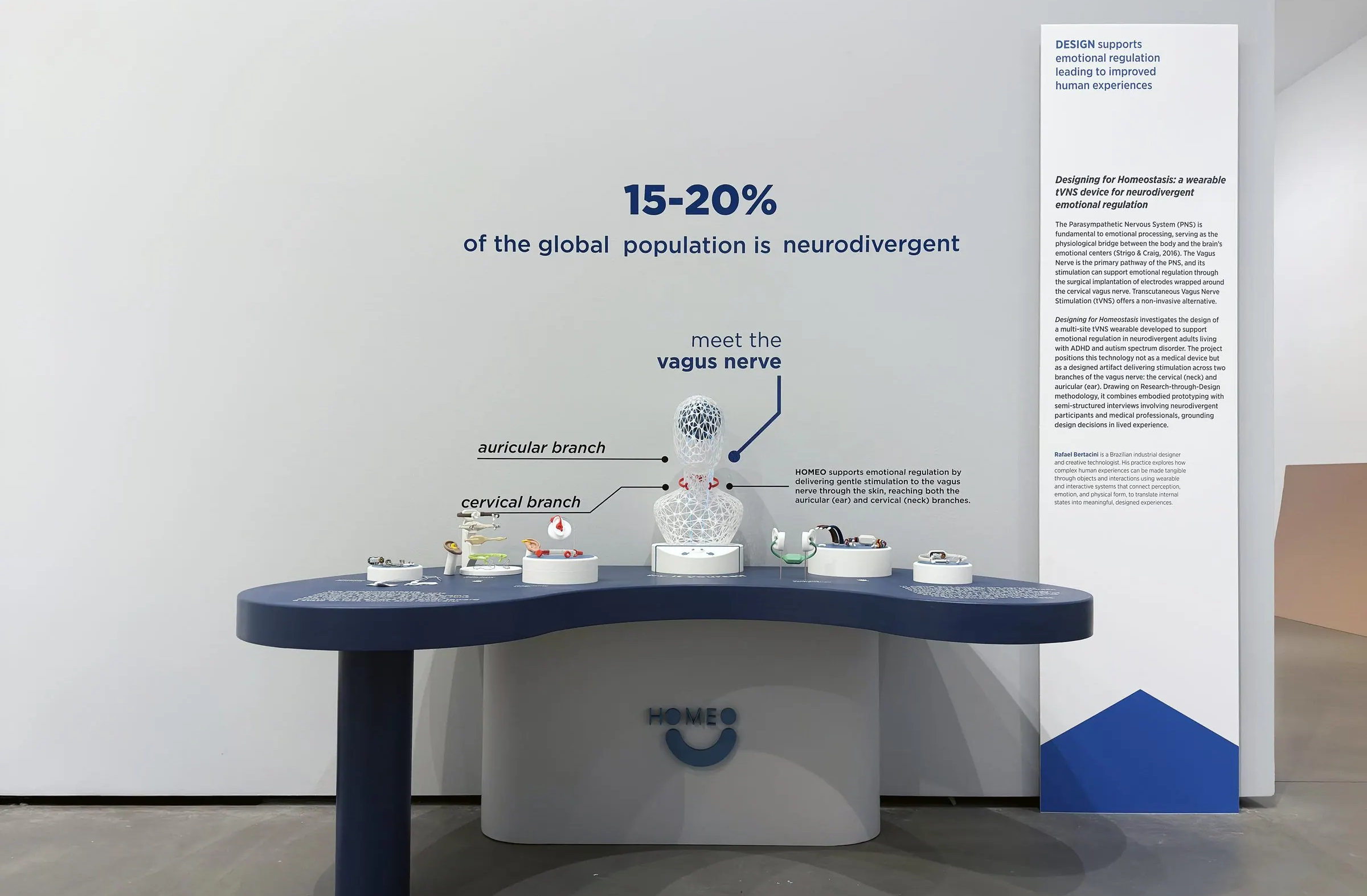
Rafael Bertacini, M.F.A., won the 2026 Savageau Award for his design, HOMEO: Designing for Homeostasis, a wearable tVNS (transcutaneous vagus nerve stimulation) device for emotional self-regulation. It sends gentle electrical pulses through the skin to the vagus nerve, helping to calm the body.

The Parasympathetic Nervous System (PNS) is fundamental to emotional processing, serving as the physiological bridge between the body and the brain's emotional centers (Strigo & Craig, 2016). The Vagus Nerve is the primary pathway of the PNS, and its stimulation can support emotional regulation through the surgical implantation of electrodes wrapped around the cervical vagus nerve. Transcutaneous Vagus Nerve Stimulation (VNS) offers a non-invasive alternative.
Designing For Homeostasis investigates the design of a multi-site tVNS wearable developed to support emotional regulation in neurodivergent adults living with ADHD and autism spectrum disorder. The project positions this technology not as a medical device but as a designed artifact delivering stimulation across two branches of the vagus nerve: the cervical (neck) and auricular (ear), Drawing on Research-through-Design methodology, it combines embodied prototyping with semi-structured interviews involving neurodivergent participants and medical professionals, grounding design decisions in lived experience. Jiayi Young, chair of the Department of Design, said, “The awards committee was impressed by the project’s exhibition design, research foundation and prototyping process.” Read more about HOMEO here.

Rafael Bertacini is a Brazilian industrial designer and creative technologist. His practice explores how complex human experiences can be made tangible through objects and interactions using wearable and interactive systems that connect perception, emotion, and physical form, to translate internal states into meaningful, designed experiences.